Nouns & Verbs | Identifying & Rephrasing
In informal speech, using a verb as a noun may be acceptable. But we’ll show you three strategies to avoid this conversion when writing.
Continue reading: Nouns & Verbs | Identifying & Rephrasing

In informal speech, using a verb as a noun may be acceptable. But we’ll show you three strategies to avoid this conversion when writing.
Continue reading: Nouns & Verbs | Identifying & Rephrasing
You’re not alone in your confusion between choose and chose. After all, the pronunciation and the extra “o” are the only things that set these words apart.
So, how do you use them correctly?
Below, we’ll go over their definitions and synonyms, and provide you with a definitive guide on their usage, so you’ll never find yourself asking, “What’s the difference between choose and choose?”
Let’s begin!
Continue reading: Chose vs Choose | Meaning, Difference & Synonyms
How do I spell languages, places, and nationalities correctly? Why should I be sensitive about where to put a hyphen?
Continue reading: Politically Correct Language | Writing with Care and Clarity
A prefix is a letter or group of letters that are added to the beginning of a word to change its meaning. For example, “bi-” is a prefix that means “two.” Therefore, bicycle refers to “a human-powered two-wheeled vehicle.”
Continue reading: Prefix | Meaning & Examples
Linking words, connectives, or transition words all refer to the same words or constructions that facilitate coherence in your texts. They can fulfill various functions (adding, contrasting, elaborating). It’s important to separate them from the main clause by using a comma.
Continue reading: Linking Words | Examples & List
So, you’ve studied English vocabulary fervently. You’ve even done the unthinkable and made sense of the endless number of grammar rules. You’ve made it. “I’m a fluent English speaker,” you say to yourself.
Until one day, someone comes up to you and says, “Are you okay? You’re high-key acting sus, no cap.” Before you can decipher that sentence, he continues, “We’re all vibing over here, but we low-key want to know what’s the tea.” You flail your arms in dismay and give up learning English.
But it doesn’t have to be that way. What you’ve just run into is slang. And trust us when we say, there’s a lot more where that came from.
Learning English slang words is just like learning any other type of word—it takes practice and familiarization. That’s why we’ve compiled a list of current terms commonly used in everyday English. We’ll tell you what they mean and give you example sentences to show you how to use them correctly.
This list will make you a more fluent English speaker, no cap.
Continue reading: English Slang Words | 25 Common Examples & Meanings
Did you know that a handful of unspoken rules govern proper email etiquette? They may not be explicitly written anywhere, like in a guide or book, but they’re widely known and often strictly followed.
Perhaps you’re aware of this obscure and mysterious set of rules but find yourself uncertain about the specifics. We’re here to clear up the haze by listing the key guidelines you should follow, but before we do, let’s first explain what email etiquette even means.
Continue reading: Email Etiquette | Rules for Professional Communication
If you’re trying to choose between LanguageTool and Grammarly, here’s why LanguageTool is the better option. It detects more typos, offers tools for all kinds of users, and is easier to use. Plus, Grammarly only covers English, while LanguageTool supports multiple languages.
Continue reading: LanguageTool vs Grammarly | 4 Key Differences
Continuous and continual come from the same Latin word—“continuus”—but they have slightly different meanings.
Don’t panic! There’s an easy visual trick that can help you remember what these words mean. We’ll show you below and go over definitions, synonyms, and example sentences to illustrate how to use continuous and continual correctly.
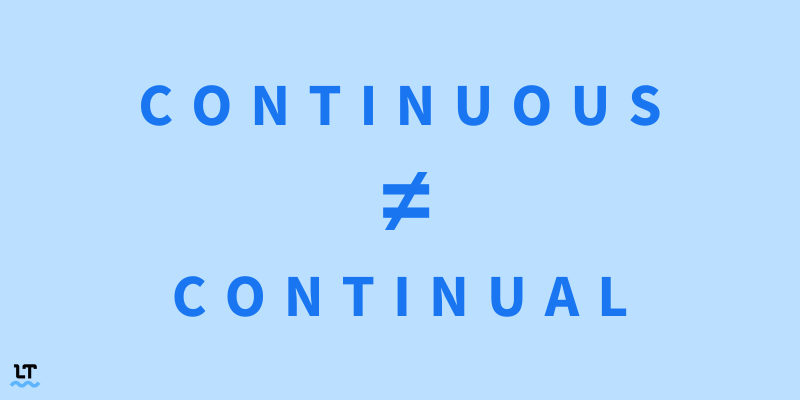
This wasn’t always the case, though. Read on to learn a bit more about the history of these two words.
Continue reading: Continual vs Continuous | Difference & Examples
No worries is a shortened version of do not worry about it or there’s nothing to worry about. The phrase is primarily used in casual conversations. Another way of saying no worries professionally is it’s no trouble at all.
Continue reading: No Worries Synonyms | 7 Professional Alternatives